
Join the Reddit Community Discussion
Check out our official thread in r/AiAutomations
A Plain-English Look at AI Automation
AI automation gets thrown around a lot right now, usually attached to either wild promises or vague buzzwords. Strip away the marketing and it's a fairly simple idea: software that can understand information, apply logic, and take action on its own — without a person handling every step by hand.
For a business owner trying to figure out whether any of this actually applies to them, that's really the starting point.
The Difference Between Automation and AI Automation
Traditional automation has been around for years, and it's rule-based: if this happens, then do that. A form gets submitted, an email goes out. It works, but it's rigid — it can only follow the exact path it was built for.
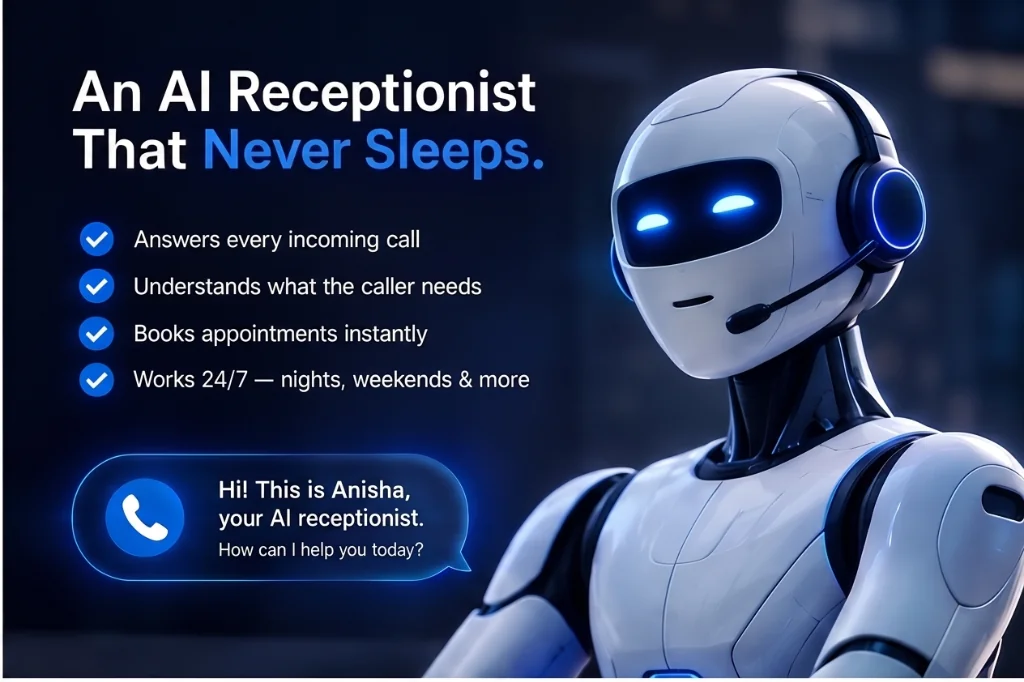
AI automation adds a layer of understanding on top of that. Instead of only reacting to a fixed trigger, it can interpret language, make judgment calls within set boundaries, and handle situations that aren't perfectly identical every time. A voice agent that can tell the difference between someone calling to book an appointment and someone calling with a billing question is a simple example — that's not something a basic 'if this, then that' system can do on its own.
Live · Anhayo AI Receptionist
Where AI Automation Actually Shows Up in a Business
In practice, this tends to look less like science fiction and more like quietly solved problems. A phone system that answers every call and books appointments without anyone sitting at a desk. A workflow that automatically replies to a customer review, drafted in a tone that sounds like the business owner wrote it. A lead that fills out a form on your website and gets added to your CRM, followed up with, and scheduled — without anyone touching a keyboard.
None of these are flashy on their own. That's usually the point. The businesses getting the most value from AI automation aren't using it for anything dramatic — they're using it to close small, repeated gaps that were quietly costing them time or customers.
One-time wiring · n8n
Every lead lands in one place. Automatically.
Zero manual entry
from lead to booked
Website form
AI agent
CRM
Calendar
What It's Not
It's worth being direct about the limits here too. AI automation isn't a robot that runs your entire business, and it isn't something you set up once and never think about again. It has to be built around how your business actually operates — the questions your customers ask, the way you currently book appointments, the tools you already use. Set up carelessly, it creates more confusion than it solves.
Why More Small and Mid-Sized Businesses Are Looking Into It Now
A few things have shifted at once. Customers increasingly expect a fast response, regardless of business size — a missed call or a slow reply now competes against businesses that respond instantly. At the same time, the tools behind this kind of automation have become far more accessible than they were even a couple of years ago, no longer limited to companies with in-house development teams.
That combination is why smaller businesses are starting to look seriously at automation that used to feel out of reach. It's less about keeping up with a trend and more about not being the slowest option in a market where speed increasingly decides who gets the sale.
Response Time
Hours down to seconds.
WhatsApp + web leads
(illustrative)
Every lead answered the moment it arrives — no waiting for a human to open the inbox.
A Simple Way to Think About the Payoff
Owners weighing whether any of this is worth pursuing tend to overcomplicate the math. A more useful way to think about it: how many hours a week currently go into tasks that don't require human judgment, and how many opportunities — calls, leads, follow-ups — slip through simply because nobody had time to get to them. Those two numbers, even estimated roughly, usually tell you more than any general statistic about 'AI adoption' ever could.
It's also worth separating time saved from opportunities recovered, because they tend to show up differently. Time saved is immediate and easy to notice — a task that used to take an hour now takes none. Recovered opportunities take longer to see, since they show up as leads that convert instead of leads that quietly disappear, which is harder to track unless you're already looking for it.
24/7
Call coverage
Before automation
With Anhayo AI
Nights, weekends, and busy hours no longer mean voicemail. Every call gets answered.
How to Know If It's Worth It for Your Business
The businesses that benefit most usually have one thing in common: a repeated task or bottleneck that eats real time every week — missed calls, manual follow-up, admin work that piles up. Whether that means a single AI voice agent handling your phones, a broader set of automations running behind the scenes, or one specific tool like a WhatsApp bot, the right starting point depends entirely on where your business is actually losing time.
If you're not sure where that is yet, that's a reasonable place to start the conversation. A discovery call is a low-pressure way to map out where automation would actually make a difference for you, rather than guessing.
Join the Community Discussion on Reddit
We regularly share AI automation strategies, voice receptionist architectures, and operational insights with fellow builders. Join our discussion thread on Reddit: